During the school year, I relied on running to melt knots in my thinking about research or teaching challenges. It’s only now, during summer break as I focus on research and my move to Michigan, that running’s only purpose is to run and fill my mind with nothing but the run. For an academic prone to overthinking, that’s harder than it sounds.

I’ve been reading a page or two here and there of Dainin Katagiri’s Returning to Silence: Zen Practice in Everyday Life, a soulful book on Vipassana meditation. Vipassana is a Zen meditation style that calls on the practitioner to sit, setting aside thought and ego in order to simply feel and be and see things as they really are rather than experiencing our own projections of what they are “supposed” to be. The end is to be at peace and to reduce suffering. Click here for a thorough explanation.

The Auburn Unitarian Universalist Fellowship has sessions every first and third Saturday at 10 a.m., and I sat zazen there for the first time in a long, long while last weekend.

The first 10 minutes were challenging. My mind raced with things I planned to do, such as writing projects and chores and arrangements for the move. Then I remembered to gently remind myself that the purpose of zazen is to sit and be present, not to ponder the past or focus on the future. I visualized a pebble dropping into a pool of water in the creek where I grew up in Kansas in an exercise I learned at the first Vipassana group I’d sat with at Ecumenical Christian Ministries at the University of Kansas some 20 years ago.

With my mind still and my attention on following my breath, feeling the fullness of my lungs and abdomen on inhaling and the emptiness on exhaling, aches and pains in my back and spine showed up. “Where did those come from?” I thought, followed by me reminding myself, “It doesn’t matter. What matters is to notice them, bless them, and release them.”

It is remarkable how following the breath reveals stresses we’ve been ignoring because we’ve been so busy. More remarkable is the way letting yourself just grow full and empty with your breaths can melt away those pains.

The routine at AAUF is to chat a little bit while waiting for everyone who’s coming to show up, listen to a Zen reading relating to Vipassana and/or loving-kindness and peace, sit zazen for 20 minutes, do walking mindfulness meditation, then sit zazen another 20 minutes, followed by a second reading. By the end of the second zazen session, I had no idea where the time went. I knew only that I felt tremendously restored and asked myself once more why I hadn’t been sitting zazen more often.

With that in mind, I thought I would try Vipassana running tonight.

The idea is to let the run be just a run: no using it as a way of working out research or teaching problems, no planning for the rest of the week, no pondering finances or cooking or other mundane matters.

The purpose of the run is to run, notice the world and the wind and the heat and the landscape, and to follow the breath. It’s OK to get caught up in the beauty of the world momentarily; such reveries are the poetry that makes life wonderful.

But attention must return to the breath (in, fullness; out, emptiness), strides (foot rising, foot falling, foot striking, foot rising, foot falling, foot striking), and aches and pains. It’s OK to set a timer on the stopwatch, but I found myself running past the 12-minute countdown timer I had set. It just felt better to run until I felt I needed to rest, then walk awhile mindfully, then resume running.

Getting started was easy; for the first few minutes it was “rise, fall; empty, full; lift, land.” Project outlines and organizational matters darted into my head and bounced around until I remembered:

“The purpose of the run is to run.”

I noticed the moon, waxing full, over the Old Rotation, Auburn’s historic experimental ag research station, where innovations in cotton, corn, and field pea crop rotation were discovered early in the last century. The sweet scent of magnolias would not be ignored.

Again: “The purpose of the run is to run.” Step. Step. In. Out. Full. Empty. Heat up. Cool down.

A familiar pattern emerged: The distractions were thick for the first 10 minutes, followed by focus and the occasional mechanical self-inventory:

  • “Does my foot hurt because I landed on it wrong, or because it’s been hurting all this time and this is the first time I’ve been mindful enough to notice the pain?”
  • “Is my lower back sore because I’m running with bad posture, or because it’s injured?”
  • “Am I gasping because I didn’t inhale as deeply as I should have, or because I’m about to have an allergy attack?”

And then: “Mmmm. Magnolias.” “Oh! That moon!” “Oooooh, that breeze.”

I don’t know, come to think of it, whether mindfulness was easier to maintain during running meditation than sitting meditation. Was I just more pleasantly distracted? Is it OK to be mindful of the world we move through as well as the body we occupy while in running meditation? Is being aware of both simply a way of being at one with the world?

I don’t know the answers to these questions. I do know I feel restored. At peace.
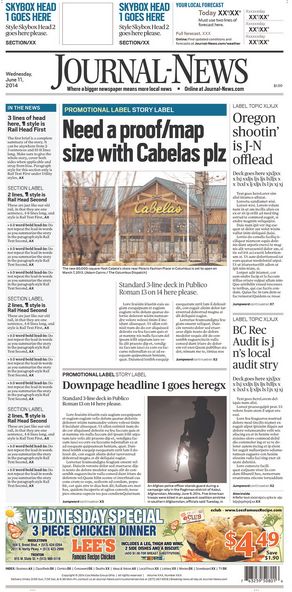
Poynter has a trivial little piece about a newspaper that accidentally sent an electronic front-page dummy to Newseum’s gallery of front pages. No, that dummy copy didn’t appear as today’s front page of the Hamilton, Ohio, Journal-News, so it’s really a no-harm, no-foul situation. But it’s an excellent reminder why you should never put joke headlines and filler on electronic dummies.

To the desk’s credit, the dummy contained no stupid pranks and no dirty inside jokes, which have certainly gotten papers in hot water in the past. But the Newseum glitch brings to mind a designer who was fired at the St. Louis Post-Dispatch some years back (2005? 2006?) after sticking a filler line that read “DRINK VODKA” at the bottom of a column of type that came up short of the assigned space.

C’mon, folks. Always seek the inoffensive fix in that instance. Two possibilities are to insert a soft return on a dense paragraph to create a widow or to just vertically justify the column.

Of course, this incident also brings to mind a framing question: Why did Poynter choose to blame the newspaper for its honest mistake rather than blaming Newseum for not noticing the problem and requesting a resend? Staffs are short everywhere, but isn’t getting the right front page more central to Newseum’s mission than sending the right one is to the Journal-News?

 
Dummy page on Newseum

The blog is taking a hiatus while I shift my attention to research. Nothing like a conference paper deadline to make you set aside distractions.

Before I go completely dark, though, I want to say congratulations to this spring’s crop of Auburn journalism graduates. Commencement was yesterday, I could hear the partying in all four directions from my place near the downtown fire station, and the campus was filled with happy grads and their families.

Commencement is a time for advice, so I’d like to leave you with some words of wisdom from George Saunders’ convocation speech at Syracuse University in 2013:

Your life is going to be a gradual process of becoming kinder and more loving: Hurry up. Speed it along. Start right now. There’s a confusion in each of us, a sickness, really: selfishness. But there’s also a cure. So be a good and proactive and even somewhat desperate patient on your own behalf — seek out the most efficacious anti-selfishness medicines, energetically, for the rest of your life.Do all the other things, the ambitious things — travel, get rich, get famous, innovate, lead, fall in love, make and lose fortunes, swim naked in wild jungle rivers (after first having it tested for monkey poop) – but as you do, to the extent that you can, err in the direction of kindness. Do those things that incline you toward the big questions, and avoid the things that would reduce you and make you trivial. That luminous part of you that exists beyond personality — your soul, if you will — is as bright and shining as any that has ever been. Bright as Shakespeare’s, bright as Gandhi’s, bright as Mother Teresa’s. Clear away everything that keeps you separate from this secret luminous place. Believe it exists, come to know it better, nurture it, share its fruits tirelessly.

I’m awfully proud of you all. Go make the world a better place.

Much wailing and gnashing of teeth have greeted this week’s Associated Press style change on when to abbreviate and when to spell out state names. Read on for a mnemonic inspired by the Beastie Boys.

The AP memo reads: “Effective May 1, the AP will spell out state names in the body of stories. Datelines will continue to use abbreviations.”

Here’s my mnemonic: Spell out “Illinois” in the body of a story. But in datelines, captions and party affiliations, you’re still licensed to “Ill.”

Now if only there weren’t two kinds of state abbreviations to choose from. As long as we’re simplifying style rules, why not choose one kind of state abbreviation? We have “Ill.” unless you have a mailing address, in which case “IL” is required.

I’m not writing this to complain; I think AP’s rationale of seeking efficiency is laudable. AP style is always evolving. Maybe the next step will move further toward simplicity and uniformity of rules.

If we move to using just one set of state abbreviations (and I’m sure a lot of people would hate this because it just doesn’t look right), I’d opt for the postal abbreviation.

Why?

I confess my thinking is influenced by understanding how the Google Fusion Tables application works. It understands either spelled-out state names (Kansas, for instance) or two-letter, capitalized postal abbreviations (KS). “Kan.” does not exist to Google Fusion Tables.

If you try to import a spreadsheet with geocoded data and merge it with a KML file to create a heat map, you’ll get the geocoding equivalent of the Millennium Falcon’s hyperdrive not working again: You expect to lurch into the hyperspace of data visualization, but the result is a disappointing lack of heat map. Going postal might be ugly to look at, but what works, works.

Melita Garza

Melita Garza’s work on Latin American culture in media

Rahul Mitra

I study organizational communication and the environment. (Mainly.)

MEL COULSON

What I think, What I do, Who I am

Marc Hemingway

Trying to keep track of my life (and my life on track)

Auburn Baseball Blog

Auburn starts the year with a new coach and a new direction and focus to win.

Overriding Ordinary

"Society is unity in diversity." -George H. Mead

The Changing Newsroom

New Media. Enduring Values.

Ed Mooney Photography

The official blog of Ed Mooney Photography. Dad of 3, Photographer, Blogger, Powerlifter. Exploring the historical sites of Ireland.

In Flow with Otto

Creativity is within us all

participation2011

NYU/Topics in Media Criticism

The Press and The Bench

Interaction between the media and the courts

The Buttry Diary

Steve Buttry, Dearly Departed Husband, Father and Grandfather. Former Director of Student Media, LSU's Manship School of Mass Communication

Theme Showcase

Find the perfect theme for your blog.

Auburn Campus Trends

The latest trends around Auburn, from fashion, to hot spots, to food.

Trending In Bama

All Things Happening In Alabama

Off the Vine

Life is too short to drink bad wine

AUact

What to do in Auburn after football season

Ripping Culture

Art by Derek Herscovici

Project Light to Life

A bucket list blog: exploring happiness, growth, and the world.

Scott Priz, Dog Reporter!

Reporting on the important things- The Dogs I meet!

SSND Live

Updates from the College News Design Contest

Appetites in Auburn

Experiencing life one meal at a time

A Taste of the Plains

Taking a look at local restaurants in Auburn and Opelika.

A Foreigner on Your Own Soil

When "y'all" meets "youse guys:" An exploration of why Northerners and Southerners don't coexist in sweet tea bliss

Culture Crazed

Finding color in unexpected places

Derencz's Corner

A glimpse inside the mind of a college journalist

Joy Mayer

JOURNALISM + COMMUNITY

ACADEME BLOG

The blog of Academe magazine

Discover WordPress

A daily selection of the best content published on WordPress, collected for you by humans who love to read.

Spirit, Word, Art

Lectionary-based creative spiritual direction

Cash or Charge

Adventures in Retail's Front Line from one of america's underemployed